
Rotor Characteristics
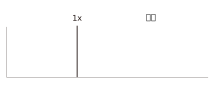
Vibration Characteristics of Imbalance
- The vibration spectrum mainly occurs at 1× rotational speed.
- The vibration direction is usually radial.
- Axial vibration amplitude is very small, much less than 1/3 of the radial vibration.
- There is almost no vibration at 2×, 3×, 4×, or other multiples of rotational speed, in both radial and axial directions.
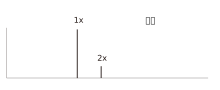
Vibration Characteristics of Shaft Bending
- Bending at the shaft center causes vibration at 1× rotational speed, with the vibration direction mainly axial.
- Bending near the coupling causes vibration at 2× rotational speed, with the vibration direction also axial.
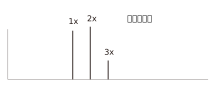
Misalignment Vibration Characteristics
- Vibration frequency mainly occurs at 1×, 2×, or 3× rotational speed.
- Since most misalignment is a combination of angular and parallel misalignment, vibration occurs in both radial and axial directions.
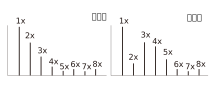
Mechanical Looseness Vibration Characteristics
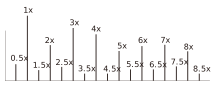
Regardless of whether it is external or internal looseness, the spectrum will show clear 1×, 2×, 3×...7×, 8×, or higher rotational speed frequencies, with similar characteristics in both radial and axial directions. However, there are slight differences between the spectra of external and internal looseness.
Shaft Friction Vibration Characteristics
- When rotating components rub against fixed components, the spectrum is similar to looseness characteristics.
- It typically excites subharmonic vibration frequencies at integer fractions of the rotational speed (1/2, 1/3, 1/4...).
Rolling Bearing Damage
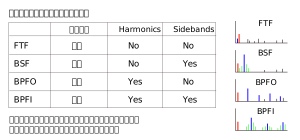
- Bearing Rolling Element Damage Frequency (BSF): BSF = 1/2 × RPM × Pd/Bb × (1 - Bd/Pd × cosø)
- Bearing Inner Ring Damage Frequency (BPFI): BPFI = 1/2 × RPM × N × (1 - Bd/Pd × cosø)
- Bearing Outer Ring Damage Frequency (BPFO): BPFO = 1/2 × RPM × N × (1 + Bd/Pd × cosø)
- Bearing Cage Damage Frequency (FTF): FTF = 1/2 × RPM × (1 × Bd/Pd × cosø)
Blade Vibration
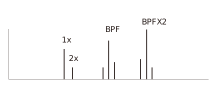
- Blade Passing Frequency (BPF) = Number of Blades × Rotational Speed (RPM). This is the natural frequency of pumps, wind turbines, and compressors.
- However, poor design, diffuser wear, pipeline sharp bends, turbulent obstacles, or shaft eccentricity can cause high BPF.
Fluid Turbulence
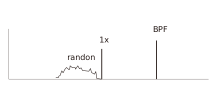
- When air enters or exits a wind turbine, sudden changes in pressure or velocity can cause turbulence.
- Turbulence typically produces random, low-frequency vibrations, ranging from approximately 1 to 30Hz.
Cavitation Phenomenon
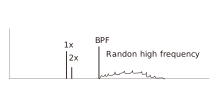
- When the pump inlet pressure is insufficient, cavitation (vapor bubble formation) is likely to occur.
- Cavitation usually generates random, high-frequency, and broad-spectrum vibrations, causing corrosion inside the pump.
Gear Vibration (Normal)
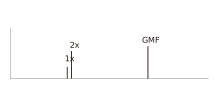
- Gear Mesh Frequency (GMF) = Number of Gear Teeth × Rotational Speed
- GMF is the inherent frequency of a gear mechanism, and its magnitude represents load level, not wear condition.

Gear Vibration (Abnormal)
- The spectral characteristics of gear wear, eccentricity, or misalignment show excitation of the gear's natural frequency fn.
- GMF increases, and sidebands related to gear wear become more pronounced. Eccentricity or shaft misalignment causes the appearance of twice the GMF frequency.
Belt and Pulley (1)
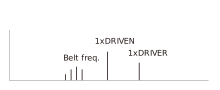
- Belt frequency = 3.14 × Pulley Diameter × Rotational Speed / Belt Length.
- When a belt is worn, loose, or improperly fitted, it often generates 1x, 2x, 3x, and 4x belt frequency vibrations.

Belt and Pulley (2)
- When the pulley is misaligned, high vibration appears at 1x rotational speed, particularly along the shaft.
- The rotational frequency of the driven component will be visible in the spectrum of the driven system.
Belt and Pulley (3)
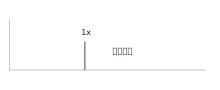
- When pulley eccentricity occurs, its vibration spectrum characteristics are similar to imbalance issues, mainly occurring at 1x rotational speed in the radial direction.

Motor Stator Eccentricity
- Stator eccentricity causes an uneven air gap, leading to vibrations.
- An uneven air gap generates localized heating, which can cause motor shaft bending, increasing vibration over time, and resulting in high vibrations at twice the line frequency (120Hz or 100Hz).

Motor Stator Abnormality
- Stator slot frequency = Number of slots × Rotational speed.
- When stator slot abnormalities occur, high vibration at stator slot frequency is observed.
- Stator slot frequency is accompanied by sidebands at motor rotational speed.
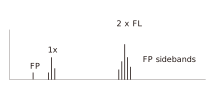
Motor Rotor Eccentricity
- Rotor eccentricity generates twice the line frequency and is accompanied by pole-pass frequency (FP = P × Hysteresis frequency).
- FP appears in the low-frequency range (approximately 0.3–2.0 Hz).
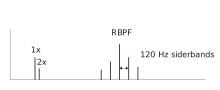
Motor Rotor Bar Loosening
- Rotor Bar Pass Frequency (RBPF) = Number of Rotor Bars × Rotational Speed.
- When rotor bars become loose, RBPF and 2xRBPF occur, accompanied by sidebands at 2xFL (120Hz or 100Hz).
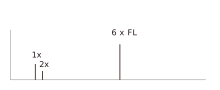
DC Motor Abnormalities
- Damaged field windings, faulty SCR, or loose connectors can cause high vibration at 6x line frequency (360Hz or 300Hz).